<
Business Owner Planning

Life beyond the business

Two people working at a desk with laptops, discussing notes on a paper with sketches and text.
Icons showing airplane, shoe, bed, Wi-Fi, energy, bulb, car, cloud, shield, and user profile in black and white.

It is your business; step away on your own terms.

When the business is the focus, the personal plan can fall behind. Bridge the gap while building, before a sale, or after one. Concentration in the business, deferred compensation, executive insurance, and the planning around an eventual exit all need their own framework.

We build the personal plan that determines whether the business grows, shrinks, or sells. Our focus is on managing broader holdings, sequencing compensation against tax math, sizing real insurance exposure, and planning deals before a major sale.

Investment discipline for the years ahead

Painting showing a glass carafe and a goblet with water on a table by a window, in a decorative frame.

Concentration managed across the wealth

Woman in glasses and white sweater standing by a window in a dimly lit bar with pink stools.

Pre-sale work begun years ahead

Top view of a spiral staircase surrounding a green garden, with a person reaching toward the plants.

The exit as a personal planning event

Wildflowers in yellow, pink, red, and purple in front of a brick building with white-trimmed windows.

The plan that runs past the sale

The business is usually the largest exposure on the owner's personal balance sheet. The wealth around it gets built to absorb that risk: diversified holdings sized to the concentration, liquidity reserved for the years it's needed, and risk calibrated to what the household can carry.

The decisions that determine after-tax outcomes from a sale get set up years before the LOI. Trust structures, gifting strategies, charitable vehicles, entity restructuring, and the tax positioning that frames the transaction all need time the deal doesn't give.

The sale of a business is the largest single planning event of an owner's life. Tax positions, estate documents, investment allocation, and retirement income all reset at the moment proceeds land.

Selling the business is the end of one financial life and the start of another. Liquidity arrives all at once, the household identity shifts, retirement reshapes, and philanthropy and new ventures become real options.

How the work happens

01
First conversation
02
The full picture
03
Building the plan outside the company
04
Putting it to work
05
Through every change

01

First conversation

Before any company analysis, there's a real conversation about where you are with the business and where the personal side connects. The company growing faster than the planning around it, an LOI on the desk, a sale just closed, a deferred-comp election approaching, or a sense that the concentration has gotten bigger than the rest of the picture. By the end you'll know whether this fits and what working together involves.

Two people at a table with one reading a book, the other holding a cup, muffins and plant nearby.

02

The full picture

On the company side: ownership structure, current valuation, capitalization, deferred comp schedules, buy-sell arrangements, equity grants outstanding. On the personal side: cash, investments, real estate, retirement accounts, other interests, family structure, tax history, existing documents. The plan reconciles to both.

03

Building the plan outside the company

The personal plan gets built around the owner's situation and the company's life cycle. Trade-offs surface explicitly: in gifting interests before a valuation jump or holding for control, restructuring entities for tax positioning or keeping it simple, deploying liquidity into diversification, or reserving for the next venture.

Person typing on a laptop at a wooden table with plants and glass in a cozy room.

04

Putting it to work

During a sale, the M&A team handles the deal and we handle the personal side. Trust structures get established with the attorney; gifting interests happen before valuation events change their value; and entity restructuring, deferred-comp elections, and executive insurance get put in place on the schedules they require.

Black and white photo of people walking and standing near a modern building with glass and panels.

05

Through every change

The business produces events the personal plan has to respond to. For instance, funding rounds, new equity grants, valuation jumps, term sheets, due diligence, and closing. Life events arrive on their own schedule too — marriage, divorce, birth, the death of a parent, or a state move that changes the tax math.

Person pointing at a laptop screen while another hand types on the keyboard indoors.

The advisor who builds the plan is the advisor who knows the business.

Owners work with many advisors at once. The senior advisor here is the one keeping the personal picture whole through every phase: the building years, the pre-sale work, the deal, and what follows.

Our advisors keep concentrated client books so the senior advisor stays close to both pictures — business and household — year after year. When a decision crosses into tax, estate, or investment management, the specialists are in-house and one conversation away.

Redondo Beach, CA
Rob Santos
CEO

Rob works with founders, executives, and families navigating concentrated wealth, business exits, and generational planning. He founded Arrowroot in 2013 and leads the firm from Southern California.

CONNECT WITH Rob Santos
El Dorado Hills, CA
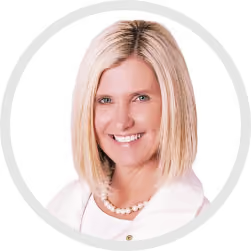
Cassandra Barry
Managing Director

Cassandra works with clients on retirement planning and Medicare strategy, with deep expertise in healthcare cost planning and the tradeoffs that shape later-life decisions. She is a licensed insurance agent with more than 12 years in financial services.

CONNECT WITH Cassandra Barry
Gig Harbor, WA
Crystal McMahon, CFP®, EA
Managing Director

Crystal works with individuals, families, and business owners on financial planning, investment management, and tax strategy. She is a CFP® and IRS Enrolled Agent with over two decades of experience.

CONNECT WITH Crystal McMahon
Denver, CO
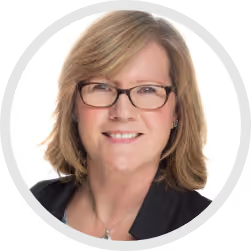
Irene Apergis
COO

Irene oversees operations and regulatory compliance across the firm. She brings more than 22 years of financial services experience across investments, capital markets, operations, management, and sales.

CONNECT WITH Irene Apergis
Charlottesville, VA
Mark McCarron, CFP®, EA
Partner, Managing Director

Mark works with families and business owners on financial planning, portfolio management, and tax strategy, with a particular focus on cash flow and long-range projections. He is a CFP® and IRS Enrolled Agent.

CONNECT WITH Mark McCarron
Rochester Hills, MI
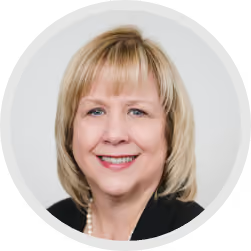
Diane Young, AIF®
Partner, Managing Director

Diane works with individuals, families, executives, and retirees on retirement planning, investment strategy, and long-term wealth management. She is an Accredited Investment Fiduciary® with over 30 years of experience.

CONNECT WITH Diane Young

How it all connects

Business Owner Planning

Tax Planning

Investment Management

Insurance

Icon of a sheet of paper with a folded corner and a checkmark on it.

Retirement Planning

Financial Planning

Equity Compensation

Estate Planning

Stacked coins and a city skyline overlaid with financial charts and data.

Business Owner Planning

Building a business creates a personal wealth situation the business itself won't manage. Concentration in the company, deferred compensation, an eventual exit, and the retirement that follows each carry their own math. Decisions on the company side get coordinated with the personal plan so the two sides move together.  

Explore Business Owner Planning

Grid of white dots arranged in eight rows and five columns on a black background.

Tax Planning

Threads through every investment decision and every estate document. Tax efficiency depends on timing as much as choice. Decisions get made so the math holds up across decades rather than quarters.

Explore Tax Planning
Grid of white dots arranged in eight rows and five columns on a black background.

Investment Management

Built around the obligations the portfolio has to meet. Holdings fund retirement income, education, gifting, and the unexpected on schedules that match real life. Risk gets calibrated to the work, and tax planning runs through every position.

Explore Investment Management
Grid of white dots arranged in eight rows and five columns on a black background.

Retirement Planning

At the center of cash flow, tax, and investment decisions, this long phase has its own math at every stage. Income, taxes, and sequence get modeled so the timeline holds up under stress. The work continues across every transition retirement contains, since one phase rarely sets the pattern for the next.

Explore Retirement Planning
Grid of white dots arranged in eight rows and five columns on a black background.

Estate Planning

Touches every other practice the moment something changes. Estate, tax, and investment positions stay aligned so the structures still work when the time comes. Documents get revisited as the family and the assets shift.

Explore Estate Planning
Grid of white dots arranged in eight rows and five columns on a black background.

Insurance

Protects what's been built when something happens. Coverage gets sized to real exposure across business interests, dependents, and estate liquidity. As obligations shift, coverage shifts with them so the protection matches the situation.

Explore Insurance
Grid of white dots arranged in eight rows and five columns on a black background.

Equity Compensation

Stock from your employer carries three identities at once: a tax position, an investment position, and a concentration risk. Vesting, exercise, sale, and AMT decisions get weighed together rather than separately. Timing of each gets coordinated against the broader picture.

Explore Equity Compensation
Grid of white dots arranged in eight rows and five columns on a black background.

Financial Planning

Financial Planning is the practice that integrates the others into one plan. Tax decisions get made with investments in view, estate work gets shaped by the cash flow strategy, equity compensation gets calibrated against the rest of the picture. The plan holds together because one advisor guides it.

Explore Financial planning

Grid of white dots arranged in eight rows and five columns on a black background.

Let’s get started

Tell us where you are, where you're headed, and what you're working with. We'll help you get there.

Thank you! Your submission has been received!
Oops! Something went wrong while submitting the form.