<
Insurance and Risk Management

Coverage that earns its place

Smartphone and pen on paper with digital stock market graphs overlay on a workspace.
Icons showing airplane, shoe, bed, Wi-Fi, energy, bulb, car, cloud, shield, and user profile in black and white.

The best policy is the one you never need.

Insurance accumulates over decades, and it's hard to keep track of the pieces. Maybe you have a term policy from when the kids were small, disability from a job that no longer exists, an umbrella that was right for the old house, or a long-term care policy a friend recommended.

We size each policy to the exposure it's covering: life insurance to the income at risk, disability to the income that has to keep flowing, umbrella to the liability the household carries, and long-term care to the years that may eventually need it. Coverage gets reviewed as obligations shift.

Coverage that fits the picture and changes with it

Painting showing a glass carafe and a goblet with water on a table by a window, in a decorative frame.

Sized to real exposure

Woman in glasses and white sweater standing by a window in a dimly lit bar with pink stools.

Chosen on the merits

Top view of a spiral staircase surrounding a green garden, with a person reaching toward the plants.

Coordinated with the rest of the plan

Wildflower meadow with pink, yellow, and red flowers in front of an old brick building.

Reviewed as obligations shift

Every policy has a specific job to do. The size of the coverage gets set by what that job requires. We believe over-coverage is premium without purpose, and under-coverage leaves the household exposed.

Recommendations come from how a policy fits the plan, what it covers, and what it costs over time. Our compensation comes from advisory fees only, so the policy that gets recommended is the same policy we'd recommend for ourselves.

Insurance work doesn't happen in a separate silo. Life insurance affects estate liquidity, disability interacts with retirement projections, long-term care touches long-horizon income, and umbrella sets how much of the household's net worth is exposed to liability. The plan reads each policy against everything else.

Coverage that fit five years ago may not fit today. The mortgage is smaller, the kids are out of the house, the business sold, a new property got added. The plan reviews coverage as the household shifts, so the protection stays sized to what's at risk.

How the work happens

01
First conversation
02
What you have and what's at risk
03
Sizing the protection
04
Putting it to work
05
Through every change

01

First conversation

Before any policy review, there's a real conversation about what brought you here. Often it's a renewal that came in higher than expected, a broker pushing a new policy, a major life change the current coverage doesn't reflect, or a sense that the policies aren't talking to each other anymore. By the end you'll know whether this fits and what working together involves.

Two people at a table with one reading a book, the other holding a cup, muffins and plant nearby.

02

What you have and what's at risk

Every policy in force: life, disability, long-term care, umbrella, property, business, vehicle. Every exposure on the other side: income at risk, household liability, dependents, assets, estate liquidity needs. Gaps between the two sides become the work.

Person typing on a laptop at a wooden table with plants and glass in a cozy room.

03

Sizing the protection

Each policy gets sized to the exposure it covers. The work runs on specific numbers: the income that would need replacing, the working years still ahead, the liability exposure under a worst-case scenario, the projected cost of late-life care. Trade-offs surface explicitly: term versus permanent, level versus increasing benefits, group versus individual policies.

Woman sitting on sandy beach watching a child standing near the water's edge with waves in background.

04

Putting it to work

New policies move through application, underwriting, and into force. Existing policies that don't fit get replaced or canceled. Beneficiary designations get updated to match the current plan. The full coverage set gets documented so the household knows what's where.

Black and white photo of people walking and standing near a modern building with glass and panels.

05

Through every change

Insurance gets reviewed as exposures shift. Like with a new mortgage, a child becoming an adult, a property bought or sold, a business changing hands, or a spouse's job changing. Each one resets what's at risk, and the coverage resets with it.

Person pointing at a laptop screen while another hand types on the keyboard indoors.

The advisor who places your coverage is the advisor who keeps it current.

Insurance work runs longer than the placement. Reviews happen at every life event and on a regular schedule between them. When a claim has to be filed, the same advisor walks through the process. As the household shifts, coverage shifts with it.

Senior advisors carry concentrated client loads so the relationship has room for consistent attention.

Redondo Beach, CA
Rob Santos
CEO

Rob works with founders, executives, and families navigating concentrated wealth, business exits, and generational planning. He founded Arrowroot in 2013 and leads the firm from Southern California.

CONNECT WITH Rob Santos
El Dorado Hills, CA
Cassandra Barry
Managing Director

Cassandra works with clients on retirement planning and Medicare strategy, with deep expertise in healthcare cost planning and the tradeoffs that shape later-life decisions. She is a licensed insurance agent with more than 12 years in financial services.

CONNECT WITH Cassandra Barry
Gig Harbor, WA
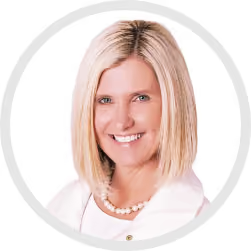
Crystal McMahon, CFP®, EA
Managing Director

Crystal works with individuals, families, and business owners on financial planning, investment management, and tax strategy. She is a CFP® and IRS Enrolled Agent with over two decades of experience.

CONNECT WITH Crystal McMahon
Denver, CO
Irene Apergis
COO

Irene oversees operations and regulatory compliance across the firm. She brings more than 22 years of financial services experience across investments, capital markets, operations, management, and sales.

CONNECT WITH Irene Apergis
Charlottesville, VA
Mark McCarron, CFP®, EA
Partner, Managing Director

Mark works with families and business owners on financial planning, portfolio management, and tax strategy, with a particular focus on cash flow and long-range projections. He is a CFP® and IRS Enrolled Agent.

CONNECT WITH Mark McCarron
Rochester Hills, MI
Diane Young, AIF®
Partner, Managing Director

Diane works with individuals, families, executives, and retirees on retirement planning, investment strategy, and long-term wealth management. She is an Accredited Investment Fiduciary® with over 30 years of experience.

CONNECT WITH Diane Young

How it all connects

Business Owner Planning

Tax Planning

Investment Management

Insurance

Icon of a sheet of paper with a folded corner and a checkmark on it.

Retirement Planning

Financial Planning

Equity Compensation

Estate Planning

Stacked coins and a city skyline overlaid with financial charts and data.

Business Owner Planning

Building a business creates a personal wealth situation the business itself won't manage. Concentration in the company, deferred compensation, an eventual exit, and the retirement that follows each carry their own math. Decisions on the company side get coordinated with the personal plan so the two sides move together.  

Explore Business Owner Planning

Grid of white dots arranged in eight rows and five columns on a black background.

Tax Planning

Threads through every investment decision and every estate document. Tax efficiency depends on timing as much as choice. Decisions get made so the math holds up across decades rather than quarters.

Explore Tax Planning
Grid of white dots arranged in eight rows and five columns on a black background.

Investment Management

Built around the obligations the portfolio has to meet. Holdings fund retirement income, education, gifting, and the unexpected on schedules that match real life. Risk gets calibrated to the work, and tax planning runs through every position.

Explore Investment Management
Grid of white dots arranged in eight rows and five columns on a black background.

Retirement Planning

At the center of cash flow, tax, and investment decisions, this long phase has its own math at every stage. Income, taxes, and sequence get modeled so the timeline holds up under stress. The work continues across every transition retirement contains, since one phase rarely sets the pattern for the next.

Explore Retirement Planning
Grid of white dots arranged in eight rows and five columns on a black background.

Estate Planning

Touches every other practice the moment something changes. Estate, tax, and investment positions stay aligned so the structures still work when the time comes. Documents get revisited as the family and the assets shift.

Explore Estate Planning
Grid of white dots arranged in eight rows and five columns on a black background.

Insurance

Protects what's been built when something happens. Coverage gets sized to real exposure across business interests, dependents, and estate liquidity. As obligations shift, coverage shifts with them so the protection matches the situation.

Explore Insurance
Grid of white dots arranged in eight rows and five columns on a black background.

Equity Compensation

Stock from your employer carries three identities at once: a tax position, an investment position, and a concentration risk. Vesting, exercise, sale, and AMT decisions get weighed together rather than separately. Timing of each gets coordinated against the broader picture.

Explore Equity Compensation
Grid of white dots arranged in eight rows and five columns on a black background.

Financial Planning

Financial Planning is the practice that integrates the others into one plan. Tax decisions get made with investments in view, estate work gets shaped by the cash flow strategy, equity compensation gets calibrated against the rest of the picture. The plan holds together because one advisor guides it.

Explore Financial planning

Grid of white dots arranged in eight rows and five columns on a black background.

Let’s get started

Tell us where you are, where you're headed, and what you're working with. We'll help you get there.

Thank you! Your submission has been received!
Oops! Something went wrong while submitting the form.